The Greed Tax
Why even elite pros keep making the “obvious” mistake.

Pick a number between 1 and 100.
Got one? Hold it. I'm going to guess what you didn't pick.
You almost certainly didn't pick anything ending in a zero: not 10, not 30, not 70, not 90. And odds are good you didn't pick anything ending in 5 either. What you most likely picked is a number with a 7 in it: 37, 67, 73, or 77. If your number isn't one of those exactly, it's a safe bet it contains a 7, is odd, isn't round, and sits somewhere in the 20s, 30s, 60s or 70s. In other words: you likely picked a number that feels random, but in reality any number between 0 and 100 is random.

When the YouTube channel Veritasium ran this exact survey, roughly 200,000 of their viewers responded. The chart above strips out 1, 2, 42, 69 and 100 (anchoring effects from the prompt itself and lol memes), and what's left is the cognitive bias on its own: peaks at 7, 37, 73 and 77 (plus 99, a "just shy of the boundary" pick), multiples of ten otherwise flat against the floor (50 the lone exception, lifted by a "middle of the range" shortcut), the right tail sagging because numbers above 80 just don't "feel" random enough to most people. There's a stage trick built directly on this pattern, the "37 force," and it works on a meaningful slice of any room.
Here's the part that is particularly interesting to me as a poker player: people produced this lumpy mess under ideal conditions. No financial pressure, no decision fatigue or a prolonged downswing that influenced their decision. Just: pick a number.
And they still couldn't do it.
Surely pro’s are able to mix. Right?
There's an obvious problem with that chart: the sample is just random people on the internet. And while everyone on the internet is, of course, a world-class expert in absolutely everything, it might still be worth separating the genuine elite from the regular Joes. Surely once we look at the 1% of the 1% in their field, the effect dissolves. Right?
Well, it doesn’t.
An illuminating example I found researching this article comes from a study by Bar-Eli, Azar, Ritov, Keidar-Levin and Schein (2007), who analyzed 286 penalty kicks from top leagues and championships worldwide. The setup is the simplest possible mixed-strategy game: the kicker picks left, center or right; the goalkeeper picks left, center or right; both decide simultaneously, because the ball reaches the goal in about 0.2 seconds. Let’s first look at where kickers typically landed their shots:

So far, so good. Kickers spread their shots roughly evenly across the goal. So far, so good. Now let’s look at what goalkeepers ended up doing:

Goalies didn’t spread at all. They went left or right in 94% of the penalties that were analyzed. And now we get to the most interesting part, the save rate:

When goalies stay center they stop 33% of all kicks, but when they dive in either direction they stop only 13 to 14% of the penalties analyzed. Standing still is roughly 2.5 times more effective than diving, yet the pros only picked it 6% of the times.
The authors' explanation for this mis-alignment is action bias. If you dive and the ball goes the other way, you feel like you "did your best," you tried. If you stand still however and the ball sails past, you look lazy, regardless of whether the math said staying was right. The regret from inaction-with-bad-outcome feels worse than the regret from action-with-bad-outcome. So you dive, every time.
If this rings a bell, it should. It is the same instinct that makes the river call feel terrible when you are wrong and the river fold feels safe, even though the EV for calling might be higher.
The main point: these are elite professionals, facing this exact decision dozens of times across their careers with millions on the line, and they still get the math wrong, consistently, simply because of how their brains weigh regret.
I see the same thing constantly in poker. After coaching 300+ players through the Mentorship Program and the NachosPoker CFP, I’m convinced that learning to manage your own biases, risk aversion, and emotional response to outcomes is one of the biggest things holding serious players back.
The Greed Tax
Imagine: you're down six buy-ins for the session and another 13 this month alone. You tell yourself that things will turn around soon, but it's hard not to get agitated. But then finally you catch a break: you river a set. Your opponent checks, and you have to choose a bet size.
You click the preset for 75%, 24bb into a 32bb pot. You sit there with the cursor floating over the bet button, but it doesn't feel quite right, so you do what every reasonable human being would do: you scroll up three pips and bet 27bb. Your opponent tanks for a moment, then folds. You sigh. Why do they only call me when I'm bluffing?
Well, the answer can be found in the data:

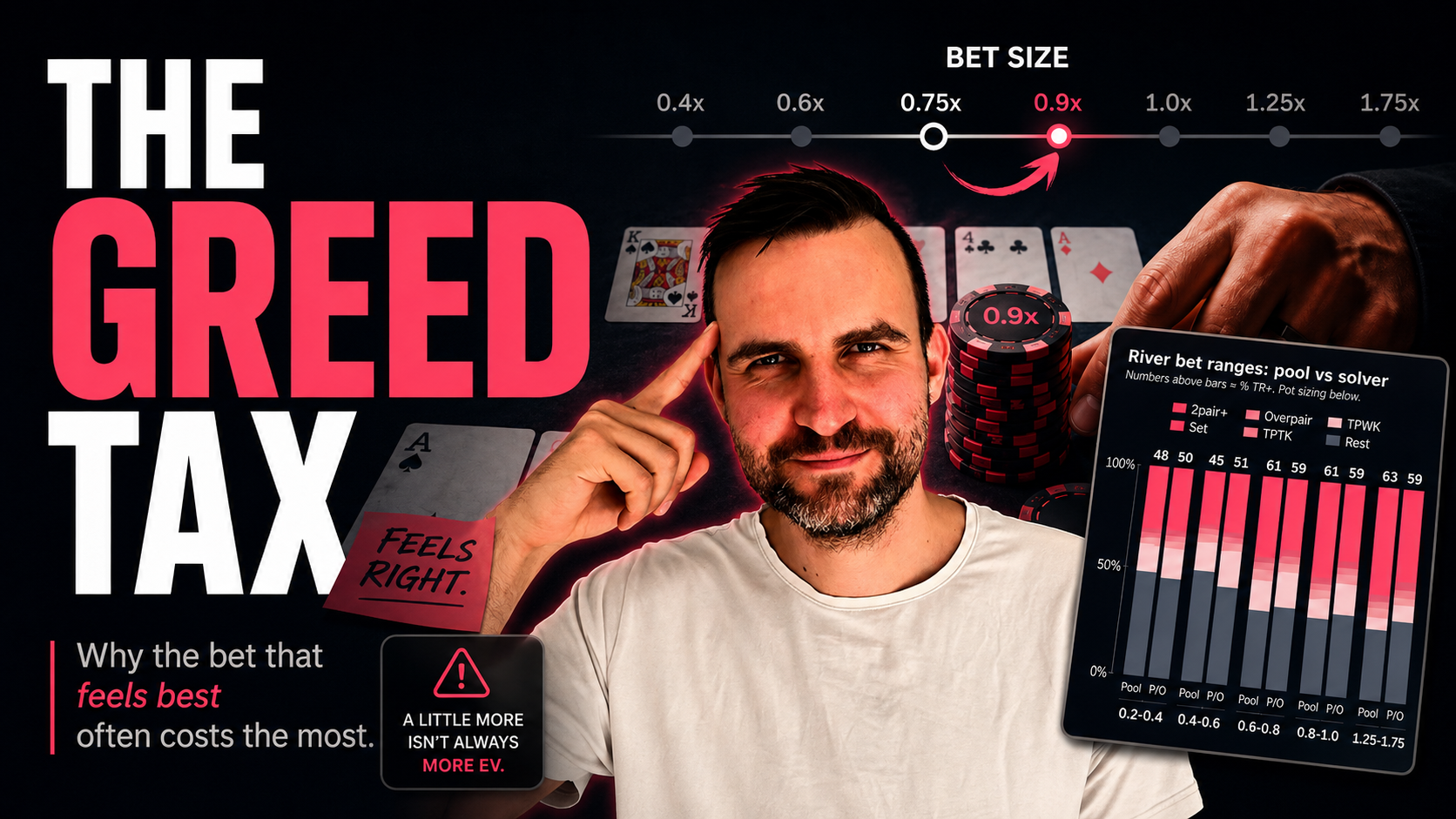
Pool versus solver, five sizing bands. The bars on the left of each pair show the pool's actual range for any river bet, in any line, across regulars with 100k+ hands at 1000nl and up on GGPoker. The bars on the right show the solver's range for that same bet size. Below 60% pot the gap is small, sometimes slightly under, sometimes slightly over, but in the neighborhood of correct. From 60% up, it diverges. Look at the rightmost three bands:

In the chart above, we can see the difference between the pool’s top pair and better frequency and the solver’s. The pattern is clear: pros prefer to bet smaller (specifically half-pot) too often when they have air, and their bets above 60% of the pot become value-packed. Iit gets worse the bigger the bet. At 0.8-1.0 pot, pool's nutted-hand share (sets and better) is 8.7 percentage points above what the solver does, and at the overbet it's still +5.9.
There might be a valid reason for this. A reg could expect, rightly, that his opponents don't raise often enough, and size up to exploit that. The most obvious explanation, though, is greed: 24bb didn't feel right, and slightly more felt slightly better, because who doesn't want to win a bit more, right?
But was it actually better?

Narrator voice: It wasn't.
Looking at the chart above, we can see that the pool folds more often than the solver does against every bet size, but especially the very small and very large sizings, it defends far less than it should. Let's look at that gap in proportional terms:

So when you have value, the sizing 2-3 pips above the good old B75 is the worst option you could pick. And that’s before you even account for a (relatively) lower raise frequency that we will face when choosing this sizing, which makes it an even worse option. This is what I'd like to call the Greed Tax, and even elite pros pay it.
Ready to plug the leaks you haven’t found yet?
Get private coaching through the Mentorship Program, or apply for the NachosPoker CFP, a team with over $7M in player winnings.